Vortex
Editorial and science-communication work for an ECMWF and Copernicus Climate Change Service case study showing how Vortex combines high-resolution wind modelling with C3S climate data to support wind-farm planning, development and risk assessment.
Overview
Vortex is a wind-resource and site-assessment service that uses meteorological modelling and climate data to support renewable-energy project development.
This project communicated how Vortex uses information from the Copernicus Climate Change Service (C3S), implemented by the European Centre for Medium-Range Weather Forecasts (ECMWF), to provide wind information for planning and safeguarding wind-energy projects.
I contributed editorial and science-communication work through Design & Data, helping turn a technical climate-services use case into a clear story about the practical value of climate data for renewable-energy decisions.
Context
Wind-energy projects depend on reliable estimates of wind conditions over long periods. Developers need to understand expected energy yield, local terrain effects, seasonal variation, extreme conditions and the uncertainty associated with a proposed site.
Direct wind measurements are valuable, but they can be limited in geographic coverage and historical duration. Climate reanalysis datasets provide a consistent, long-term record that can be combined with local modelling to support site selection, energy-yield estimates and project risk assessment.
Vortex provides online “Wind & Site” information derived from mesoscale meteorological modelling and ERA5 climate reanalysis data produced by ECMWF. [web:231]
The challenge
The project needed to communicate a complex technical chain in practical terms:
Global climate reanalysis → high-resolution meteorological modelling → site-specific wind information → renewable-energy development decisions
This meant explaining why climate data matters to audiences beyond meteorology and Earth observation, including wind-farm developers, investors, engineers, planners and policy stakeholders.
The editorial challenge was to make the connection between climate data and energy infrastructure concrete:
- How can a long-term climate record help estimate wind resources?
- Why do local terrain and atmospheric conditions matter?
- What does downscaling add beyond coarse global information?
- How can climate services reduce uncertainty during project development?
- How can data support more resilient renewable-energy investment?
Vortex and C3S
Vortex uses C3S data for its online wind-modelling services.
The Copernicus Climate Change Service provides climate information based on observations, models and reanalysis. ECMWF operates C3S on behalf of the European Union and produces the ERA5 global climate reanalysis dataset used in many climate-service applications. [web:231]
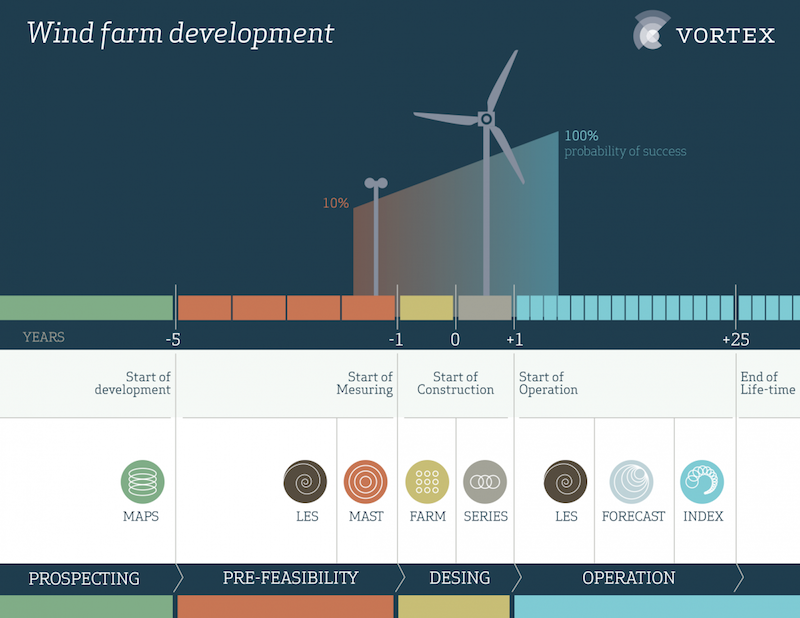
Vortex combines large-scale climate information with mesoscale modelling to produce wind-resource data at a more useful spatial scale for energy projects. Its services are designed to support planning and risk management across the renewable-energy project lifecycle. [web:231]
My role
I worked as an Editor and science communicator through Design & Data.
My contribution supported the editorial development of an ECMWF and Copernicus Climate Change Service user story, explaining how Vortex applied climate data to a commercial and operational renewable-energy context.
The work included:
- Translating climate-service concepts into accessible language.
- Developing a clear narrative around renewable-energy decision-making.
- Explaining the relationship between reanalysis, modelling and wind-resource assessment.
- Supporting video and multimedia communication.
- Connecting technical data infrastructure with its social, commercial and environmental value.
Editorial approach
The central editorial idea was simple:
Climate data helps turn uncertainty about future energy resources into better evidence for renewable-energy decisions.
Rather than presenting ERA5 or mesoscale modelling as isolated technical products, the story followed the route from data to outcome.
Climate record
→ Wind conditions
→ Site assessment
→ Energy-yield estimate
→ Project planning and investment
This approach gave the viewer a practical reason to care about climate services: they help developers make more informed choices when designing renewable-energy infrastructure.
Wind-resource modelling
Wind conditions vary across time and geography. A site can be affected by large-scale weather patterns, seasonal shifts, land cover, elevation, terrain, surface roughness and local flow effects.
Vortex uses numerical weather modelling to translate broader atmospheric conditions into higher-resolution wind information. Its modelling workflow uses Weather Research and Forecasting (WRF)-based approaches and high-performance computing to downscale atmospheric data for wind-resource applications. [web:233]
The resulting information can be used where direct measurements are limited, while still requiring appropriate validation, local expertise and careful interpretation in project-specific decisions.
Outcomes
The completed case study and video supported public and professional communication around the use of Copernicus Climate Change Service data in the renewable-energy sector.
Key outcomes included:
- An accessible explanation of a C3S climate-service application.
- Clearer communication of how wind-resource modelling supports wind-farm planning.
- A practical example of climate data contributing to renewable-energy development.
- Video material associated with the European State of the Climate event in April 2018.
- A reusable narrative linking Earth observation, climate science, energy systems and investment decisions.
Related media
Related work
This project is connected to wider ECMWF and Copernicus communications work on climate services, environmental data and the practical use of Earth observation.
See also:
Limitations
This project concerned editorial communication and climate-service storytelling. It did not involve developing the Vortex platform, producing ERA5 itself or operating the underlying wind models.
Modelled wind-resource information is not a substitute for all on-site measurement and engineering assessment. Results depend on data quality, model configuration, local terrain, observation availability and the specific requirements of a proposed energy project.
Keywords
Vortex; ECMWF; Copernicus; C3S; ERA5; wind energy; renewable energy; wind resource; mesoscale modelling; climate services; Earth observation; science communication; editorial strategy.
Vortex uses C3S and ECMWF-produced ERA5 reanalysis data alongside mesoscale modelling to help customers plan and safeguard renewable-energy projects. The linked 2018 video describes Vortex’s use of C3S data for online wind modelling and wind-farm development decisions.