SEPPCoN: Survey of the Ensemble Physical Properties of Cometary Nuclei
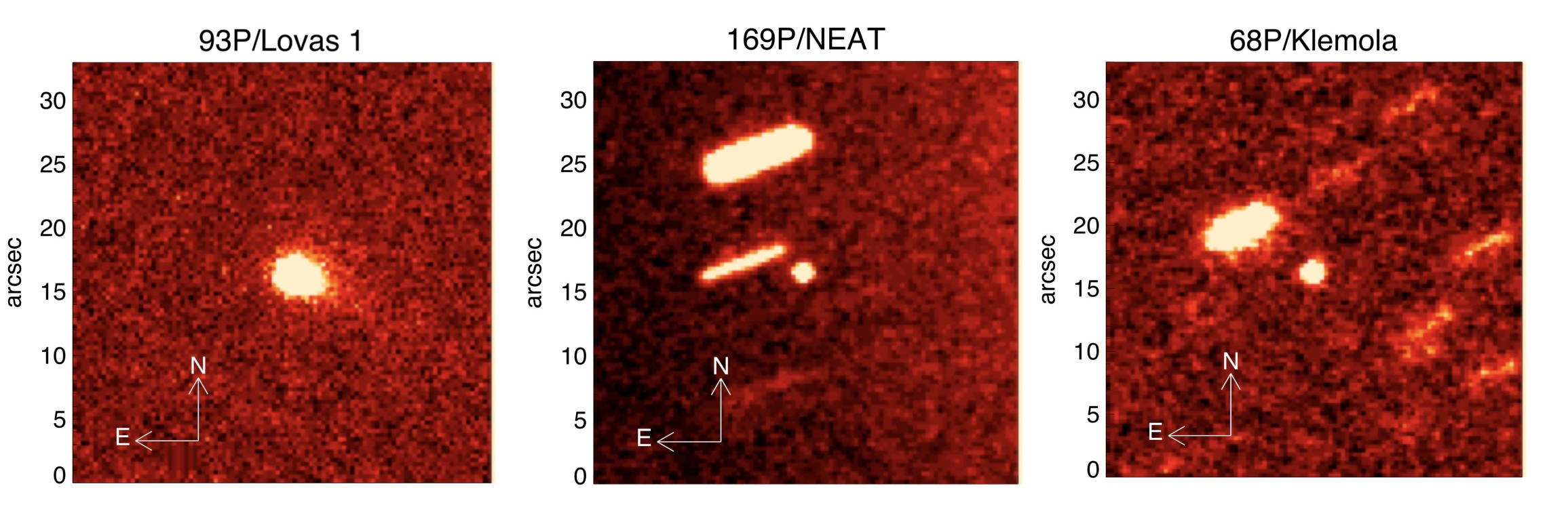
Collaborative observational programme investigating the physical and surface properties of Jupiter-family comet nuclei through thermal-infrared observations from the Spitzer Space Telescope and complementary ground-based visible-light measurements.
Overview
SEPPCoN, the Survey of the Ensemble Physical Properties of Cometary Nuclei, was a collaborative programme investigating the physical characteristics of Jupiter-family comet nuclei.
Jupiter-family comets are short-period comets whose orbits are strongly shaped by Jupiter. Their nuclei are relatively primitive Solar System bodies, making them useful targets for studying the composition, structure and evolutionary history of material left from planet formation.
The programme combined thermal-infrared measurements from the Spitzer Space Telescope with visible-light observations from ground-based telescopes. This multi-wavelength approach was used to constrain nucleus sizes, surface reflectivity and thermal behaviour for a large sample of cometary nuclei.
Research objectives
The project aimed to improve population-level understanding of Jupiter-family comets by addressing several connected questions:
- What are the typical sizes and geometric albedos of cometary nuclei?
- Is there evidence that albedo varies systematically with nucleus size?
- What do thermal measurements reveal about the surface properties of nuclei?
- How does the size distribution of observed nuclei inform models of cometary evolution and the small-body populations of the Solar System?
- Can thermal and visible-light observations be combined to reduce uncertainty in estimates of nucleus size and reflectivity?
Observations
Spitzer Space Telescope
Spitzer observations measured thermal emission from cometary nuclei at mid-infrared wavelengths. The programme used imaging capabilities associated with the Infrared Spectrograph (IRS) and the Multiband Imaging Photometer for Spitzer (MIPS), including observations around 16 and 22 micrometres.
Thermal-infrared observations are particularly valuable because they provide a constraint on the heat emitted by a body. When combined with visible-light measurements, they help break the degeneracy between an object’s physical size and its surface reflectivity.
A small, bright object and a larger, dark object can have similar brightness in visible light. Thermal emission provides additional information that enables more reliable estimates of effective radius and geometric albedo.
Ground-based optical observations
Ground-based visible-light observations complemented the Spitzer measurements. They provided photometry and contextual observations needed to interpret the thermal signal and separate nucleus properties from the effects of cometary activity, dust and observing geometry.
Together, the space- and ground-based observations supported a more robust physical characterisation of individual comets and the wider Jupiter-family comet population.
Methods
The analysis combined thermal-infrared fluxes with optical photometry to derive physical parameters for cometary nuclei.
Key steps included:
- Measuring thermal emission at mid-infrared wavelengths.
- Using visible-light observations to constrain reflected sunlight.
- Applying thermal models to estimate effective nucleus radii.
- Calculating geometric albedos from combined thermal and optical constraints.
- Comparing derived properties across the survey sample.
- Examining the cumulative size distribution of Jupiter-family comet nuclei.
The programme also considered thermal inertia, a property describing how quickly a material responds to heating and cooling. Low thermal inertia is consistent with a porous, dusty and weakly conducting surface layer.
Findings
SEPPCoN results indicated that many Jupiter-family comet nuclei have low thermal inertia, consistent with surfaces that are porous, dusty and relatively poor conductors of heat.
Preliminary analysis of the cumulative size distribution found a power-law slope similar to results from visible-light studies. This suggested that there was no strong evidence for a systematic relationship between nucleus size and albedo across the observed sample.
The survey provided a larger and more consistently analysed dataset for evaluating the physical properties of Jupiter-family comet nuclei than was available from isolated observations alone.
Contribution
I contributed to the SEPPCoN collaboration while associated with the Centre for Astrophysics and Planetary Science at the University of Kent.
My involvement formed part of doctoral research activity in planetary science and astronomical observation. The programme brought together collaborators working on Spitzer thermal-infrared data, ground-based optical measurements, physical modelling and population-level analysis of Jupiter-family comets.
Scientific context
Cometary nuclei preserve material from the early Solar System and may retain information about the environments in which planetesimals formed. Understanding their size distribution, albedo and thermal properties helps connect present-day comet observations with models of Solar System evolution.
Jupiter-family comets are especially important because their orbits bring them into the inner Solar System, where their nuclei can be studied in detail. However, activity, dust and observational selection effects can complicate physical interpretation. Combining thermal-infrared and visible-light measurements provides a stronger basis for estimating intrinsic nucleus properties.
Related presentation
Results from the SEPPCoN Survey of Jupiter-Family Comets
S. C. Lowry, Y. Fernández, R. Laird, M. F. A’Hearn, J. M. Bauer, H. Campins, A. Fitzsimmons and collaborators
Results from the programme were presented at the European Planetary Science Congress. The presentation described a survey of approximately 100 Jupiter-family comets, using Spitzer observations of thermal emission together with extensive ground-based optical monitoring.
Limitations
Cometary nuclei are difficult targets because activity can obscure or alter the signal from the solid nucleus. Thermal models also depend on assumptions about surface roughness, emissivity, rotation, observing geometry and thermal properties.
The project therefore provides population-level constraints rather than a complete physical description of every observed comet. Derived radii and albedos should be interpreted alongside model assumptions and the quality of the available optical and thermal measurements.
Keywords
Jupiter-family comets; cometary nuclei; planetary science; Spitzer Space Telescope; thermal infrared; geometric albedo; thermal inertia; small bodies; Solar System evolution; photometry.