P/2010 A2 asteroid collision confirmed by Rosetta/OSIRIS
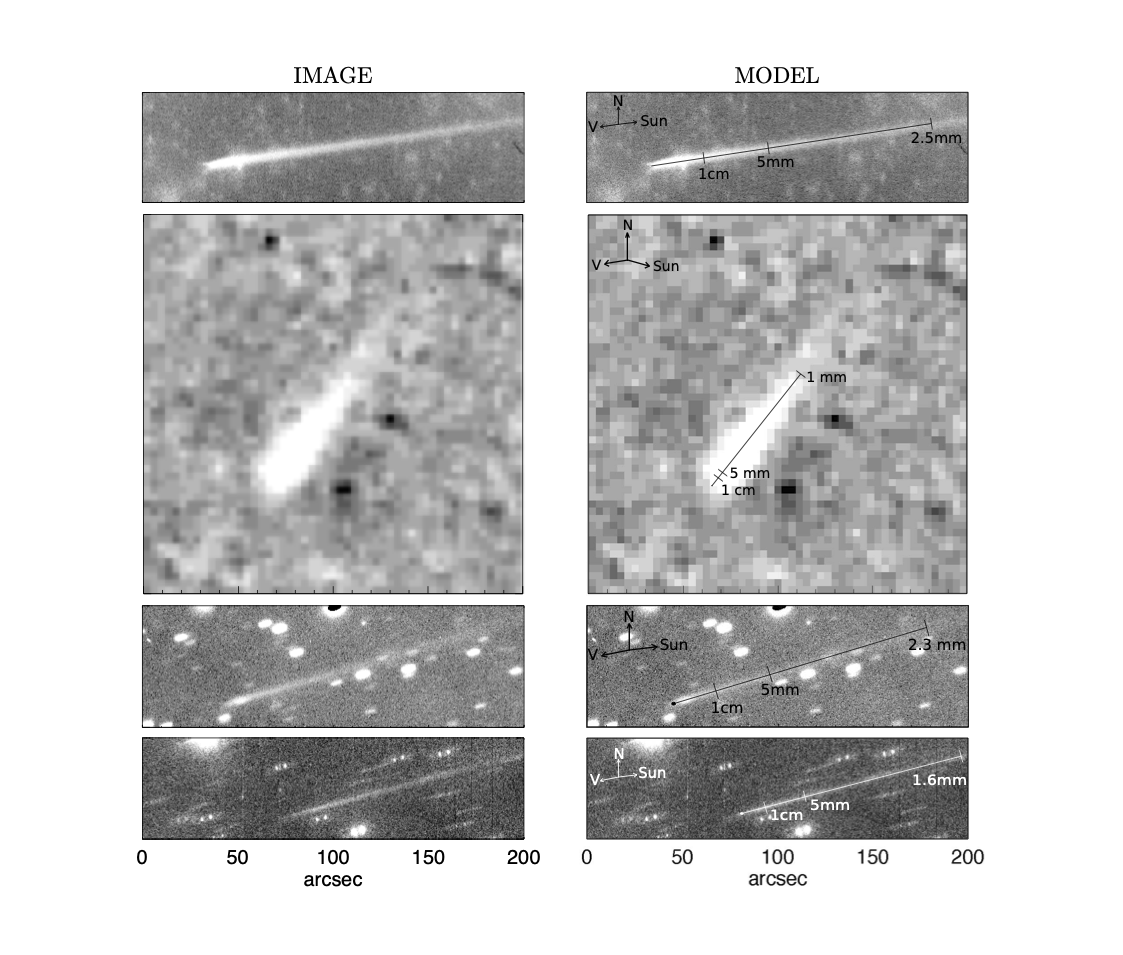
Collaborative analysis of ESA Rosetta/OSIRIS observations and ground-based imaging that established P/2010 A2's comet-like dust trail as debris from a single asteroid collision in the main belt, rather than sustained cometary activity.
Overview
P/2010 A2 was discovered by the LINEAR survey in January 2010 as an unusual object in the inner main asteroid belt. It appeared to have a long, diffuse trail resembling a cometary tail, yet it showed no clear coma or central condensation associated with ordinary cometary activity.
The object quickly became a target of interest because its orbit was asteroidal, while its visible appearance suggested dust loss. Early interpretations considered whether it could be a main-belt comet: an asteroid whose visible activity is driven by sublimating volatile material.
Subsequent observations revealed a small surviving nucleus separated from the main dust trail. This made a different explanation plausible: the visible structure could be debris created by a recent collision between asteroids.
This collaborative project used a rare observation from ESA’s Rosetta spacecraft, together with ground-based telescope imaging and dust-dynamics modelling, to determine the origin of the trail.
Research question
Was P/2010 A2 an active main-belt comet, or was its trail produced by a single impact event?
A related aim was to establish when the dust was released and to constrain the properties of the particles shaping the visible trail.
Why Rosetta mattered
From Earth, P/2010 A2 was observed from a relatively limited range of viewing angles. Several physical scenarios could produce similar projected trail shapes, making it difficult to determine whether the observed dust arose from ongoing cometary activity or an impulsive collision.
Rosetta provided a unique vantage point.
In March 2010, the spacecraft was travelling through the asteroid belt on its route to comet 67P/Churyumov-Gerasimenko. Its orbit was inclined relative to P/2010 A2’s, allowing the OSIRIS camera system to view the object from a substantially different phase angle than was available from Earth.
Although P/2010 A2 was faint in the Rosetta images, this alternative geometry was decisive. Combined with observations from Earth, it enabled the research team to constrain the three-dimensional form and evolution of the debris trail.
Observations
Rosetta/OSIRIS
The object was observed on 16 March 2010 using the OSIRIS Narrow Angle Camera on ESA’s Rosetta spacecraft.
The OSIRIS images showed the dust trail from a perspective unavailable to ground-based observatories. This made it possible to test whether the trail geometry was consistent with continuous emission from an active comet or with material released in a single impact.
Ground-based observations
Rosetta data were compared with complementary ground-based imaging, including observations from the New Technology Telescope and Palomar Observatory.
The combined dataset extended the available viewing geometry and supported a more robust reconstruction of the dust distribution.
Method
The team used Finson-Probstein dust-dynamics modelling to simulate the appearance of dust released from P/2010 A2.
The method models how dust particles move under the combined effects of solar gravity and solar-radiation pressure. A key parameter is beta, the ratio of solar-radiation-pressure acceleration to solar gravitational acceleration.
By varying:
- The date of dust emission.
- The initial particle distribution.
- Particle-size-related beta values.
- The viewing geometry.
- The expected effects of radiation pressure over time.
the team generated model trails for comparison with Rosetta and ground-based images.
The distinctive Rosetta viewing angle reduced the number of viable solutions. A single, impulsive release of dust provided the best match to the observations.
Findings
The combined observations and modelling showed that P/2010 A2’s trail was not produced by prolonged cometary activity.
Instead, the trail was consistent with debris released in a single asteroid collision. The preferred solution placed the event around 10 February 2009, with an uncertainty window of approximately 10 days.
The analysis indicated that the visible trail contained relatively large dust particles, broadly millimetre to centimetre scale, that remained close to the parent body. The geometry could be explained by an impact that ejected clumps of debris, which subsequently dispersed under the influence of solar gravity and radiation pressure.
This work provided direct evidence for a recent collision in the asteroid belt and offered an unusual opportunity to study the early evolution of an asteroid impact debris field.
Contribution
I contributed as part of the University of Kent group within the wider Rosetta/OSIRIS collaboration.
The research drew on expertise from institutions across Europe and the United States, combining spacecraft imaging, ground-based observation, dust-dynamics modelling and interpretation of small-body activity.
The collaboration included researchers from the Max Planck Institute for Solar System Research, University of Kent, ESA, Queen’s University Belfast, Jet Propulsion Laboratory and other partner institutions.
Scientific significance
Asteroid collisions are fundamental to the evolution of the Solar System, but they are difficult to observe shortly after they occur.
P/2010 A2 was significant because its debris remained visible soon after a recent event. The system therefore provided an opportunity to examine how impact ejecta evolves into a dust trail under solar radiation pressure and orbital motion.
The work also demonstrated the value of multi-vantage-point astronomy. Rosetta was not originally designed to study P/2010 A2, but its position in the Solar System supplied the crucial perspective needed to distinguish between competing interpretations.
Related outputs
The P/2010 A2 asteroid collision confirmed by Rosetta/OSIRIS observation
C. Tubiana, C. Snodgrass, J.-B. Vincent, H. Sierks, S. Hviid, R. Moissl, H. Böhnhardt, C. Barbieri, D. Koschny, P. Lamy, H. Rickman, R. Rodrigo, B. Carry, S. C. Lowry, R. J. M. Laird, P. R. Weissman, A. Fitzsimmons, S. Marchi and the OSIRIS team
Presented at the Division for Planetary Sciences meeting of the American Astronomical Society, 2010.
A collision in 2009 as the origin of the debris trail of asteroid P/2010 A2
C. Snodgrass, C. Tubiana, J.-B. Vincent and collaborators
Nature, 467, 814–816 (2010).
The paper concluded that the trail resulted from a single event around 10 February 2009 rather than sustained cometary activity.
Limitations
The dust trail was observed after the collision rather than at the moment of impact. Reconstructing the event therefore depended on models of dust motion, assumptions about particle properties and comparisons between images obtained at different times and viewing angles.
The modelling strongly supported an impulsive collision, but it did not provide a direct image of the impacting object or a complete measurement of the collision’s initial conditions. Estimates of particle sizes and release geometry remain model-dependent.
Keywords
P/2010 A2; 354P/LINEAR; asteroid collision; Rosetta; OSIRIS; asteroid belt; dust dynamics; Finson-Probstein modelling; solar radiation pressure; small bodies; planetary science.