Lunar Exploration Interactive Documentary
Editorial development and content-promotion work for ESA’s Lunar Exploration Interactive Documentary, an award-winning web experience that makes lunar science, technology and future missions accessible through expert video, articles, visual storytelling and social-media campaigns.
Overview
Lunar Exploration Interactive Documentary is an ESA multimedia web experience that helps audiences explore the Moon through science, technology, missions and expert voices.
The documentary includes more than 40 videos featuring scientists involved in lunar research. Visitors can follow their own route through subjects including the Moon’s history, human exploration, robotic missions, lunar resources, spacecraft technologies and future exploration plans.
My role focused on editorial development and content promotion: shaping complex source material into accessible public stories, planning thematic campaign content and connecting audiences from ESA social channels to relevant areas of the web documentary.
My editorial role
I worked as an Editorial Contributor and Content-Promotion Planner through Design & Data.
The work was not simply about announcing the website. It involved identifying the most compelling stories within a large library of interviews, articles, technologies and mission material, then adapting them for different audiences and channels.
My responsibilities included:
- Developing clear editorial angles from technical and scientific source material.
- Writing and editing short-form copy for social-media posts.
- Preparing longer contextual copy for campaigns and content briefs.
- Selecting documentary content that matched a planned topic, event or publishing moment.
- Creating clear pathways from social posts to relevant web-documentary pages.
- Supporting promotion of the web-documentary trailer.
- Planning a recurring publishing calendar from December 2016 to June 2017.
- Aligning content with Full Moons, lunar-science events and exploration news.
- Helping ensure terminology, tone and claims were appropriate for public science communication.
Editorial challenge
The documentary covered a broad and technically demanding field.
Topics ranged from the formation of the Moon and the history of the Solar System to robotics, life support, sample drilling, navigation, communications, radiation, spacecraft landing systems and human exploration.
The editorial task was to preserve the meaning of the science while making each story understandable at a glance.
Specialist interview or technical briefing → Identify the human or scientific question → Write a concise public-facing narrative → Link to the relevant documentary video or section → Invite deeper exploration
For example, a story about a lunar drill could be framed not as a description of hardware specifications, but as a question with immediate relevance:
How can scientists collect water ice from the Moon without losing the very material they want to study?
Editorial principles
The content strategy followed several principles.
Start with curiosity
Posts began with a question, challenge or surprising fact rather than an institutional description.
Examples included:
- Could astronauts grow food and recycle waste on the Moon?
- How can a spacecraft land safely in a cratered polar landscape?
- Why are scientists drilling beneath the lunar surface?
- What can decades-old Moon rocks still tell us today?
- How could astronauts control robots on the Moon from orbit?
Use expert voices
The documentary was structured around researchers, engineers and mission specialists. Editorial copy introduced their expertise while keeping the language direct and readable.
The platform’s science content includes contributors from ESA, DLR, CNRS and universities, covering subjects such as lunar origins, resources, Solar System history and human exploration.
Make technical content useful
Each story was connected to a reason it matters:
| Topic | Editorial framing |
|---|---|
| MELiSSA | Helping astronauts sustain themselves on long missions |
| PILOT | Landing safely in difficult lunar terrain |
| PROSPECT | Drilling for and protecting samples of lunar volatiles |
| METERON | Letting astronauts control robots from orbit |
| Orion European Service Module | Supporting people beyond low Earth orbit |
| Lunar Communications Pathfinder | Returning vital data from hard-to-reach locations |
| Radiation | Reducing risks to future lunar explorers |
| Lunar samples | Using the Moon to investigate the Solar System’s history |
Offer a next step
Every campaign item was designed to point beyond itself.
A reader could encounter a short social post, watch an expert clip or follow a link to a particular library item, then discover connected material in the interactive documentary.
Content-promotion campaign
I helped develop a promotional programme running from December 2016 to June 2017.
The campaign used the site as a living editorial resource rather than a one-off launch product. It drew on existing documentary assets to create continuing reasons for audiences to return.
Lunar moment, event or topic → Social post or trailer → Link to a relevant documentary asset → Deeper exploration of related stories
The programme included:
- ESA portal and social-media promotion.
- Trailer publication on YouTube.
- Facebook, Twitter/X and Instagram copy.
- Full-Moon content moments.
- Technology-focused weekly stories.
- Science-focused features tied to expert interviews.
- Content connected to conferences and public-engagement events.
- Promotion through ESA and relevant programme accounts.
Launch editorial work
The launch activity in December 2016 paired broad visibility with targeted stories.
A feature on the ESA portal generated approximately 2,000 sessions. Social amplification through Instagram, ESA accounts, Facebook and a post by ESA astronaut Thomas Pesquet generated additional referral traffic in the campaign records.
The editorial lesson was clear: distinct voices and well-chosen entry points could introduce different audiences to the same in-depth resource.
The campaign then moved from launch messaging to a sustained programme of topic-led stories.
Trailer promotion
In February 2017, the campaign supported publication of the documentary trailer on YouTube.
Editorial work included preparing the destination message, video description, tags and links that directed viewers to the main site. The trailer was designed to show that the web documentary was not just a video series, but an interactive experience that visitors could explore in their own way.
ESA’s trailer description identifies the platform as a web documentary with more than 40 scientist-led videos and encourages viewers to explore science, technology and lunar missions through the site.
Technology editorial stories
MELiSSA: life support
One campaign story introduced MELiSSA through the challenge of sustaining astronauts during long-duration missions.
The editorial narrative explained that a lunar base or Mars mission cannot rely only on resupply from Earth. Future crews need life-support systems that manage oxygen, carbon dioxide, water, food and waste.
Rather than beginning with programme terminology, the copy led with a simple human question:
How can astronauts live sustainably when there is no air, water or food outside their spacecraft?
PILOT: autonomous landing
A second story focused on PILOT, a technology concept for landing precisely and safely.
The editorial framing explained why polar terrain matters: it may contain water ice and locations with useful illumination, but it is also rugged and difficult to reach.
The copy connected navigation, hazard detection and autonomous landing with the practical challenge of getting a spacecraft safely to scientifically valuable terrain.
PROSPECT: collecting lunar samples
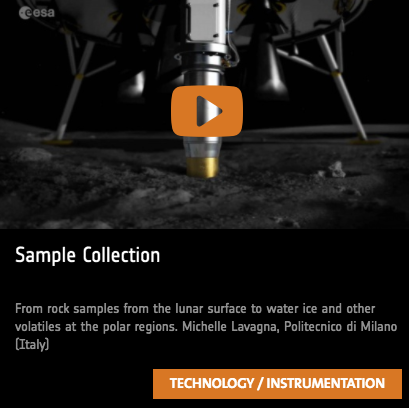
The PROSPECT story focused on a drill intended to collect and analyse material beneath the lunar surface.
The editorial challenge was to explain why drilling is difficult in a vacuum at extreme temperatures, especially when the target material may contain volatile components that can be altered by heat.
The content connected engineering detail with scientific purpose:
Drill beneath the surface → Recover cold, volatile-rich samples → Preserve them for analysis → Learn more about water and lunar history
ESA’s documentary content describes PROSPECT as a package for collecting and analysing lunar samples, while later ESA material confirms its focus on drilling and analysing polar material in the search for volatiles.
METERON: humans and robots
A METERON feature explored the possibility of astronauts controlling semi-autonomous robots from an orbiting space station.
The editorial story used the human-robot partnership as its central idea: people can provide judgement and direction, while robots can work in difficult, remote or hazardous locations.
This made telerobotics a concrete future-exploration story rather than an abstract technology demonstration.
Orion European Service Module
The editorial angle for the Orion European Service Module was that human exploration depends on fundamental systems that are mostly invisible to passengers and audiences.
The copy explained that the module provides essential resources and functions, including power, propulsion, water, gases, thermal management and course control.
The story framed these systems as the infrastructure that enables human journeys beyond low Earth orbit.
Lunar Communications Pathfinder
A separate editorial story focused on communication.
The text compared exploring the Moon with exploring an unfamiliar place through human senses. Spacecraft use instruments as their remote senses, but the measurements they collect must be transmitted back to Earth.
This framing helped explain the importance of a communications service for regions such as the lunar far side and south-polar areas.
Science editorial stories
Water in lunar samples
Campaign content drew on expert interviews to explain why old Apollo and Luna samples can yield new results.
The editorial approach contrasted early analyses with later methods, presenting the subject as a story of scientific progress: new techniques can reveal evidence that earlier instruments could not detect.
This created an accessible route into the question of lunar water and why polar exploration matters.
Moon formation
Posts tied to lunar-science events introduced competing explanations for the formation of the Earth-Moon system.
The relevant documentary section includes expert discussion of lunar origins and evolution, using Moon rocks and planetary research to explore how the Moon formed. [web:336]
Solar System history
The Moon’s surface and rocks preserve records that are often erased on Earth by weather, tectonics and active geology.
Editorial content used this contrast to explain why lunar samples and surface materials can help scientists investigate impacts, cosmic radiation and the history of the Solar System.
Human exploration editorial stories
Landing systems
A May feature translated the mechanics of spacecraft touchdown into a clear story about stability.
Landing on a surface filled with slopes, boulders, craters and loose material requires systems that absorb impact and keep a lander stable enough to operate instruments, robotic arms or rovers.
The editorial framing moved from a familiar word — touchdown — to the engineering work hidden within it.
Radiation
A second feature explained that the Moon does not have Earth’s dense atmosphere or global magnetic field.
The copy introduced the radiation risk facing future explorers and connected that challenge to the need for sensors, measurement and mitigation strategies.
The aim was to explain the issue without overstating certainty or offering health guidance.
Event-based editorial planning
The campaign also identified opportunities to connect the documentary with events where lunar science and exploration were already under discussion.
EGU General Assembly
For the 2017 European Geosciences Union General Assembly, the campaign proposed posts on:
- Lunar samples and meteorites.
- The origin and evolution of the Moon.
- The Moon’s record of Solar System history.
- Questions about early Earth and the origins of life.
The role of the editorial copy was to make the conference connection relevant to non-attendees: audiences could use the documentary to explore the ideas being discussed in Vienna.
European Lunar Symposium
For the European Lunar Symposium, planned stories highlighted:
- Theories of Moon formation.
- In-situ resources for future exploration.
- Radiation records preserved on the lunar surface.
- Interviews with contributing lunar scientists.
ECSITE and Paris Air Show
The documentary was also prepared for presentation at the ECSITE Conference and the International Paris Air Show.
For these settings, editorial work supported the framing of the documentary as both a public-learning resource and a live demonstration of ESA’s lunar exploration ambitions.
Editorial outcomes
My contribution helped establish a repeatable content model for a large interactive documentary.
Instead of treating the site as a single finished product, the campaign treated it as an editorial library:
- One expert interview could become a social post.
- One technology topic could become a public question.
- One science event could become a reason to rediscover related content.
- One Full Moon could become a timely invitation to explore the site.
This model extended the life of the documentary and made its extensive archive of expert material easier to discover.
Recognition
The project received an Award of Excellence from the Communicator Awards.
The award recognised the project’s combination of interactive design, multimedia storytelling and public-facing science communication.
Related work
This project is part of wider ESA and Design & Data work on interactive storytelling, science communication and public engagement with space exploration.
Limitations
My role was editorial and campaign-focused. I did not lead the overall website design, software development, scientific research, spacecraft engineering or ESA mission management.
Campaign traffic figures were recorded at specific moments and should be treated as indicative referral measures, not a complete attribution model for all audience behaviour. Mission plans, technologies and schedules presented in the 2016–17 documentary should also be checked against current ESA programme information.
Keywords
European Space Agency; ESA; Moon; lunar exploration; editorial development; content strategy; science communication; interactive documentary; social media; digital storytelling; lunar science; lunar technology; public engagement; Design & Data.
ESA describes the platform as an interactive web documentary featuring more than 40 scientist-led videos on lunar science, technology and missions.[1][2]
Sources [1] Videos - 2017 - 02 - The Moon – ESA’s interactive guide https://www.esa.int/esatv/Videos/2017/02/The_Moon_ESA_s_interactive_guide [2] The Moon – ESA’s Interactive Guide - European Space Agency https://www.esa.int/Education/Teach_with_the_Moon/The_Moon_ESA_s_Interactive_Guide [3] ESA Lunar Exploration https://lunarexploration.esa.int/ [4] Technology - Descent and Ascent - Ascent from the Moon https://lunarexploration.esa.int/explore/technology/226?ia=288 [5] The Moon – ESA’s interactive guide - European Space Agency https://www.esa.int/ESA_Multimedia/Videos/2017/02/The_Moon_ESA_s_interactive_guide [6] ESA’s Missions - lunar exploration https://lunarexploration.esa.int/explore/esa/233 [7] Explore - Science - Solar System History - Moon Rocks https://lunarexploration.esa.int/explore/science/223?ia=281 [8] Moon Facts https://lunarexploration.esa.int/basic-facts [9] Explore - Missions - Robotic Landers https://lunarexploration.esa.int/explore/missions/239 [10] Explore - Missions - Robotic sample return - Luna 16 https://lunarexploration.esa.int/explore/missions/238?a=317