Galaxy Facebook: X-ray source population analysis of the Galactic Centre
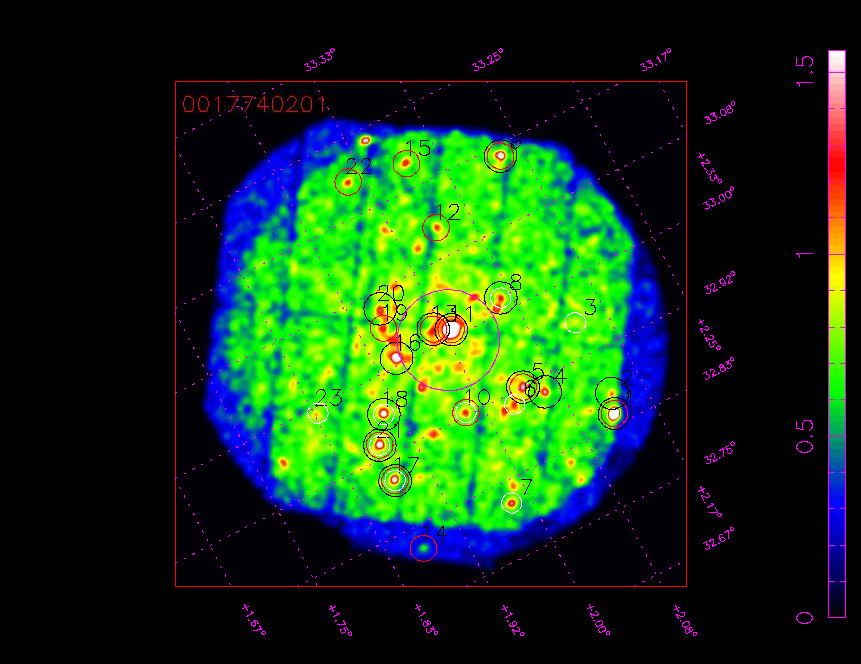
Undergraduate research project analysing XMM-Newton observations of two Galactic Ridge fields to investigate intermediate-luminosity X-ray sources, compare spectral behaviour across energy bands, and identify candidate variable or transient sources.
Overview
The Galactic Centre and Galactic Ridge contain a dense and complex population of high-energy sources. X-ray observations reveal emission from compact binaries, accreting white dwarfs, active stars, supernova remnants, diffuse hot plasma and more distant background objects seen through the Milky Way.
This undergraduate research project analysed archival observations from ESA’s XMM-Newton X-ray observatory. The work focused on discrete sources of intermediate luminosity in two fields near the Galactic plane: one centred close to the plane and a second positioned approximately two degrees away from it.
The project examined source detection, count rates, energy-band behaviour and variability across multiple observation epochs. It also compared results with the 2XMM serendipitous-source catalogue to identify candidate variable or transient X-ray sources.
Research question
What are the spectral and temporal properties of intermediate-luminosity X-ray sources in Galactic Ridge fields, and how do source populations and observed fluxes differ between a field on the Galactic plane and an off-plane field?
The work considered several related questions:
- Which sources showed substantial changes in flux between observations?
- Which energy bands contributed most strongly to individual sources?
- How did count rates differ between the on-plane and off-plane fields?
- What role might interstellar absorption play in the observed source populations?
- Could multi-epoch comparisons identify candidate X-ray transients?
Scientific context
X-ray astronomy is essential for studying compact and energetic objects that cannot be understood from visible-light observations alone.
The Galactic plane contains large quantities of gas and dust. This material absorbs lower-energy X-rays particularly strongly, so observations along the plane tend to favour harder X-ray sources or nearby objects. Comparing a plane field with an off-plane field can therefore help distinguish changes in source density from the effects of interstellar absorption.
Intermediate-luminosity sources are also important because they can include cataclysmic variables, X-ray binaries, coronally active stars and other populations that collectively contribute to the Galactic Ridge X-ray emission.
Observations
The project used archival XMM-Newton observations of two fields in the Galactic Ridge region.
Galactic Ridge 1
Galactic Ridge 1 was centred close to the Galactic plane at approximately:
Galactic longitude: 33 degrees 06 minutes
Galactic latitude: 0 degrees
The analysed observations were:
| Observation ID | Approximate net exposure |
|---|---|
0017740401 |
21 ks |
0017740501 |
25 ks |
This field was expected to be affected by substantial line-of-sight absorption and to contain a comparatively high density of Galactic X-ray sources.
Galactic Ridge 2
Galactic Ridge 2 was positioned off the plane at approximately:
Galactic longitude: 33 degrees
Galactic latitude: 2 degrees
The analysed observations were:
| Observation ID | Approximate net exposure |
|---|---|
0017740201 |
15–20 ks |
0017740601 |
15–20 ks |
0017740701 |
15–20 ks |
Moving away from the plane changes both the absorbing column and the mixture of objects visible in the field, making the comparison useful for interpreting population differences.
EPIC instruments
All observations used XMM-Newton’s European Photon Imaging Camera (EPIC):
- MOS1, a Metal Oxide Semiconductor camera.
- MOS2, a second Metal Oxide Semiconductor camera.
- pn, a higher-throughput CCD camera.
The observations used the medium optical blocking filter. Combining the three instruments improved source detection and enabled instrument-by-instrument comparison of count rates.
Method
The analysis used Leicester-developed data-analysis tools operating through
command-line Q scripts, including viewer2.qin and sources2.qin.
Data reduction
Raw and processed XMM-Newton data products were handled as FITS and HDS/FITS structures. The reduction process involved preparing data from each EPIC instrument, inspecting images, selecting source regions and extracting instrument-specific count rates.
Multi-band imaging
The source population was examined in five standard XMM-Newton energy bands:
| Band | Energy range |
|---|---|
| Band 1 | 0.2–0.5 keV |
| Band 2 | 0.5–2.0 keV |
| Band 3 | 2.0–4.5 keV |
| Band 4 | 4.5–7.5 keV |
| Band 5 | 7.5–12.0 keV |
Comparing these bands made it possible to assess whether a source was predominantly soft or hard, and to investigate the effects of absorption and spectral variation.
Source detection
Candidate point sources were identified using automated extraction procedures. The analysis considered parameters describing source extent and the fraction of counts concentrated within the detection cell to distinguish likely point-like sources from extended structure, noise and diffuse emission.
Source extraction and count-rate measurement used routines including Jill
and Jack.
Catalogue comparison
Measured source positions and count rates were compared with archival source information from:
- The 2XMM XMM-Newton Serendipitous Source Catalogue.
- The LEDAS Arnie service.
- The HEASARC archive.
This comparison provided external flux estimates, source designations and reference values for evaluating differences between epochs.
Variability analysis
For sources detected in more than one observation, count rates and derived fluxes were compared across epochs.
Sources with changes substantially larger than their formal measurement uncertainties were flagged as possible high-variability objects or candidate X-ray transients. These candidates would require deeper or follow-up observations for definitive classification.
Findings
Candidate variable and transient sources
Several sources showed flux changes that exceeded their formal uncertainties between observing epochs.
One example was source 168323, associated with 2XMM J185139.1+001635. This
source showed pronounced variability in the Galactic Ridge 1 data, with strong
emission in the 2.0–4.5 keV band. Its behaviour made it a candidate for further
investigation as a variable or transient X-ray source.
The project identified variability candidates rather than claiming definitive transient classifications. The available observations provided a limited number of epochs and were not designed as a continuous monitoring campaign.
Bright sources and energy dependence
The brightest source identified in Galactic Ridge 1 was source 168300,
associated with 2XMM J185114.3-000004.
Its EPIC flux was estimated at approximately:
6.1 × 10^-13 erg s^-1 cm^-2The source showed strong emission at higher energies, particularly in Band 5 (7.5–12.0 keV). Hard-band behaviour can indicate intrinsically energetic sources, substantial foreground absorption, or a combination of both.
On-plane and off-plane comparison
The Galactic Ridge 1 field generally showed higher active count rates than Galactic Ridge 2.
This difference was consistent with the expectation that observations close to the Galactic plane sample a denser population of Galactic X-ray sources while also experiencing stronger absorption. Soft X-ray emission is preferentially suppressed by intervening gas and dust, meaning that the observed population along the plane is weighted towards harder or less absorbed sources.
Approximate luminosity scale
Using a simple assumed distance of approximately 8 kiloparsecs, comparable to the distance to the Galactic Centre, the observed intermediate-luminosity sources corresponded broadly to X-ray luminosities around:
10^32 erg s^-1These values were indicative rather than definitive because source distances and absorbing columns were not independently determined for every object. Detailed spectral fitting and absorption corrections would be required to derive robust intrinsic luminosities.
Contribution
I completed this research as an undergraduate physics student at the University of Leicester, working with Leon Hicks under the supervision of Professor Bob Warwick.
The project provided practical experience in:
- Processing space-telescope datasets.
- Working with FITS-based astronomy data products.
- Comparing observations from multiple CCD instruments.
- Assessing X-ray source variability.
- Using archival catalogues and astronomical data services.
- Interpreting high-energy observations in the context of Galactic source populations and interstellar absorption.
Related output
X-ray source population of the nearby Galactic Centre
Ryan John McCall Laird
Undergraduate research report, Department of Physics and Astronomy, University of Leicester, 16 April 2008.
Supervised by Professor Bob Warwick.
The report documented the XMM-Newton EPIC data-reduction process, source detection workflow, energy-band comparisons, catalogue cross-matching and source flux tabulations for Galactic Ridge 1 and Galactic Ridge 2.
Scientific significance
The Galactic Ridge X-ray emission is produced by a mixture of diffuse processes and large populations of faint or unresolved point sources. Understanding the properties of intermediate-luminosity sources helps constrain the contribution made by Galactic binaries, accreting white dwarfs, active stars and other compact populations.
This project provided a small-scale observational investigation of that wider problem. Comparing fields close to and away from the Galactic plane illustrated how source populations, energy-dependent absorption and observational selection affect the high-energy view of the Milky Way.
Limitations
The observations had net exposures of approximately 15–25 kiloseconds per field. They were therefore substantially shallower than dedicated deep surveys, limiting sensitivity to faint sources and reducing the ability to classify short-duration variability.
Other limitations included:
- Detector-edge effects for sources near camera boundaries.
- Differences in effective area and response between MOS and pn instruments.
- Dependence on catalogue cross-calibration when converting count rates to physical fluxes.
- Uncertain distances to individual sources.
- Absorption corrections not modelled in detail for every source.
- Limited temporal sampling, which prevents firm classification of transient candidates without follow-up data.
The analysis should consequently be interpreted as an exploratory source population study and as evidence for candidate variability, rather than a complete census or definitive classification programme.
Keywords
Galactic Centre; Galactic Ridge; XMM-Newton; EPIC; MOS1; MOS2; pn; X-ray sources; X-ray transients; high-energy astrophysics; FITS; data reduction; 2XMM; interstellar absorption.