Keeping Gaia's Memory
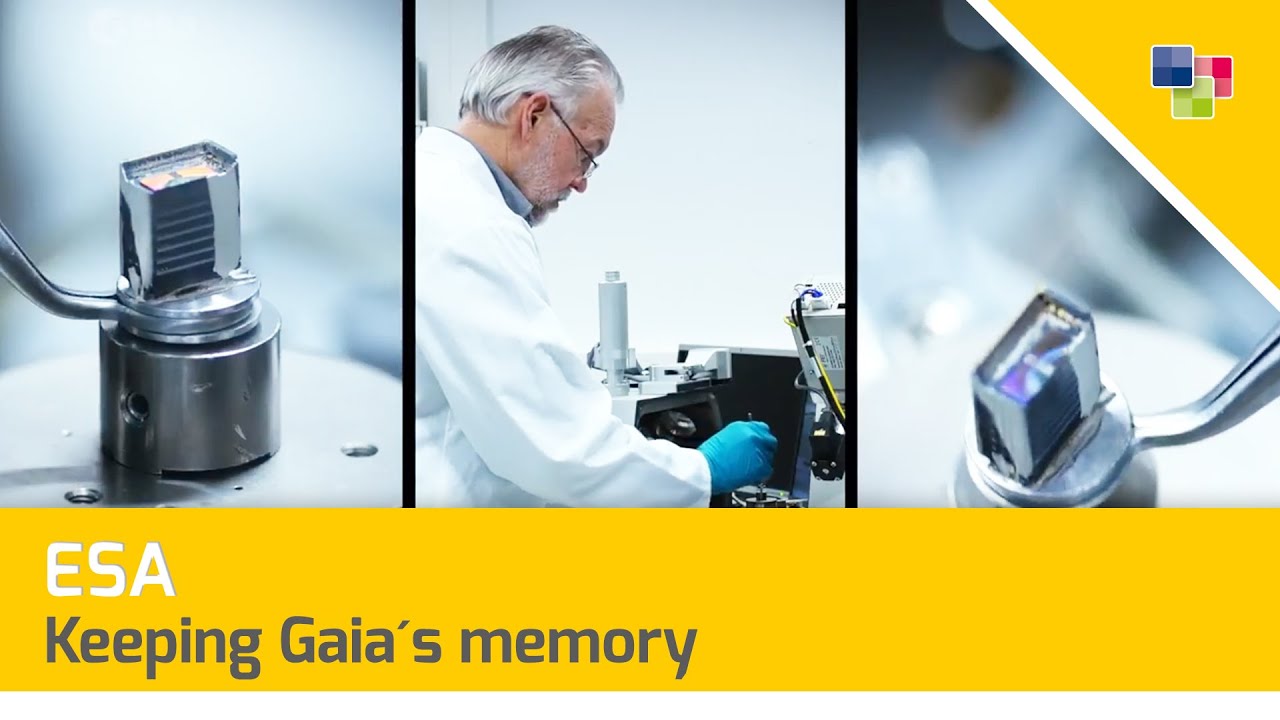
Script development for an ESA documentary about diagnosing a failed onboard memory module during pre-flight testing of the Gaia spacecraft, using non-destructive 3D X-ray tomography to determine the cause of the fault.
Overview
Keeping Gaia’s Memory is a short European Space Agency documentary about the investigation of a failed onboard memory module during pre-flight testing of ESA’s Gaia spacecraft.
Gaia was designed to collect an enormous volume of astronomical observations while mapping the positions and motions of around one billion stars. Before those measurements could be transmitted to Earth, they had to be stored safely in the spacecraft’s onboard solid-state memory.
When one memory module failed during testing, ESA’s Materials and Electrical Components Laboratory was asked to determine whether it was an isolated incident or evidence of a wider manufacturing issue. The investigation used three-dimensional X-ray tomography to inspect the module internally without destroying it.
I contributed script development through Design & Data, helping communicate how a detailed laboratory investigation can protect the reliability of a major space-science mission.
The challenge
Gaia’s scientific goal depended on the dependable operation of many individual spacecraft components.
The mission’s instruments generated data continuously, but communications with Earth could not transfer every observation immediately. The spacecraft therefore needed onboard systems capable of storing observations securely until they could be downlinked.
During pre-flight testing, one module within Gaia’s onboard “hard disk” failed. The engineering challenge was not simply to replace it: the team needed to understand why it failed and determine whether similar components might carry the same risk.
Memory-module failure → Cause unknown → Potential manufacturing or design risk → Non-destructive internal inspection → Evidence-based decision for mission reliability
Gaia mission context
Gaia is ESA’s astrometry mission, designed to create an exceptionally precise three-dimensional map of the Milky Way.
The spacecraft measures the positions, distances, motions and physical properties of stars, enabling astronomers to investigate the structure, formation and evolution of our Galaxy.
The mission produces a large volume of observational data. Gaia’s payload data handling system includes solid-state mass memory, which stores data produced by the onboard video processing units before transmission to ground stations. [web:292]
Reliable memory hardware is therefore essential: a fault in data storage could reduce the amount of scientific information recovered from the spacecraft.
The memory investigation
One of Gaia’s memory modules failed during pre-flight testing.
ESA’s Materials and Electrical Components Laboratory investigated the component to establish whether the issue was an isolated event or part of a broader manufacturing problem. Rather than dismantling the module immediately, the team used a 3D X-ray tomography machine to examine the hardware internally. [web:290][web:291]
This approach allowed engineers to see beneath the component’s outer surface and identify the source of the fault while preserving the item for further analysis.
X-ray tomography
Three-dimensional X-ray tomography is a non-destructive imaging technique.
Like medical CT scanning, it uses multiple X-ray views to reconstruct the interior of an object. For spacecraft electronics, this can reveal internal features such as:
- Solder joints.
- Wire bonds.
- Cracks.
- Voids.
- Misalignments.
- Delamination.
- Structural defects.
- Manufacturing inconsistencies.
In the Gaia investigation, X-ray tomography enabled ESA engineers to inspect the memory module’s internal structure and identify the source of the failure without taking the component apart. [web:290]
Memory module
→ X-ray scans from multiple angles
→ 3D reconstruction of internal structure
→ Identification of the failure source
→ Improved confidence in flight hardware
Why non-destructive testing matters
Space hardware is expensive, tightly qualified and often available in limited numbers. Engineers need methods that can diagnose faults while preserving the hardware and maintaining a clear evidence trail.
Non-destructive testing can help teams:
- Identify defects inside sealed components.
- Compare failed and non-failed hardware.
- Investigate potential production issues.
- Support decisions about replacement, requalification or redesign.
- Reduce risk before spacecraft launch.
For Gaia, the test was part of the wider verification culture needed to ensure that a mission built to operate far from Earth could be trusted after launch.
My role
I worked as a Scriptwriter through Design & Data.
My contribution included:
- Developing the documentary narrative and script structure.
- Translating spacecraft-electronics and failure-analysis concepts into accessible language.
- Explaining why an individual memory-component failure mattered to a billion-star astronomy mission.
- Supporting the communication of laboratory procedures and technical imagery.
- Connecting microscopic internal evidence with mission-scale reliability.
The editorial objective was to show that space missions depend not only on spectacular imagery and advanced instruments, but also on careful engineering work carried out long before launch.
Editorial approach
The film used a familiar analogy: Gaia’s onboard memory module as part of the spacecraft’s “hard disk”.
This offered a clear route into a specialist topic:
A familiar problem — failed computer memory
→ A high-stakes context — a spacecraft preparing for launch
→ An advanced diagnostic tool — 3D X-ray tomography
→ A mission-level outcome — protecting scientific data
The narrative made the abstract idea of spacecraft qualification tangible by focusing on a specific object, a specific failure and the forensic process used to understand it.
Outcome
The completed documentary was released by ESA in June 2016.
ESA describes Keeping Gaia’s memory as a film about a memory-module failure identified during pre-flight testing, followed by a non-destructive three-dimensional X-ray tomography investigation performed by the Materials and Electrical Components Laboratory.
The film formed part of wider ESA communication activity highlighting the testing, materials research and engineering expertise that support European space missions.
Related media
Related work
This project is part of wider ESA communication work exploring materials, testing and engineering practices that support reliable spacecraft.
See also:
Limitations
This project concerned science communication and documentary scripting. It did not involve conducting the laboratory investigation, manufacturing Gaia hardware or operating the Gaia mission.
The film focused on one pre-flight component investigation. Spacecraft reliability depends on a much broader qualification programme, including environmental testing, radiation assessment, thermal-vacuum tests, vibration tests, electrical verification, redundancy analysis and system-level validation.
Keywords
Gaia; European Space Agency; ESA; spacecraft memory; solid-state mass memory; failure analysis; 3D X-ray tomography; non-destructive testing; space hardware; materials engineering; astronomy; documentary scripting; science communication.
ESA states that a Gaia onboard memory module failed in pre-flight testing and that its Materials and Electrical Components Laboratory used 3D X-ray tomography for a non-destructive investigation of the component’s internal fault.[1][2]
Sources [1] Asset Publisher https://sci.esa.int/web/gaia/-/58064-keeping-gaia-s-memory [2] Videos - Gaia - ESA Cosmos - European Space Agency https://www.cosmos.esa.int/web/gaia/media-gallery/videos [3] The Gaia mission | Astronomy & Astrophysics (A&A) https://www.aanda.org/articles/aa/full_html/2016/11/aa29272-16/aa29272-16.html [4] Flying ESA’s ultra-precise Gaia Mission - AIAA https://arc.aiaa.org/doi/pdf/10.2514/6.2016-2444 [5] GAIA Astrometry Mission - eoPortal https://www.eoportal.org/satellite-missions/gaia [6] Gaia data release 3: exploring our multi-dimensional Milky Way - ESA https://www.esa.int/ESA_Multimedia/Videos/2022/06/Gaia_data_release_3_exploring_our_multi-dimensional_Milky_Way [7] The Gaia mission - ADS - Astrophysics Data System http://ui.adsabs.harvard.edu/abs/2016A&A...595A...1G/abstract [8] ESA Gaia على X: “Names of all contributors are now being written to … https://x.com/ESAGaia/status/1905177931682349193 [9] [PDF] Gaia ESA Archive (GEA) tutorial https://indico.strw.leidenuniv.nl/event/2/sessions/5/attachments/7/6/GaiaArchiveTutorial-DeBruijne.pdf [10] Esa Gaia Mission News: Latest News, Photos, Videos & Live Updates | ABP Live English https://news.abplive.com/topic/esa-gaia-mission/amp