AMBIEnT: Affordable Microsatellite-Based Internet Access and Environmental Monitoring
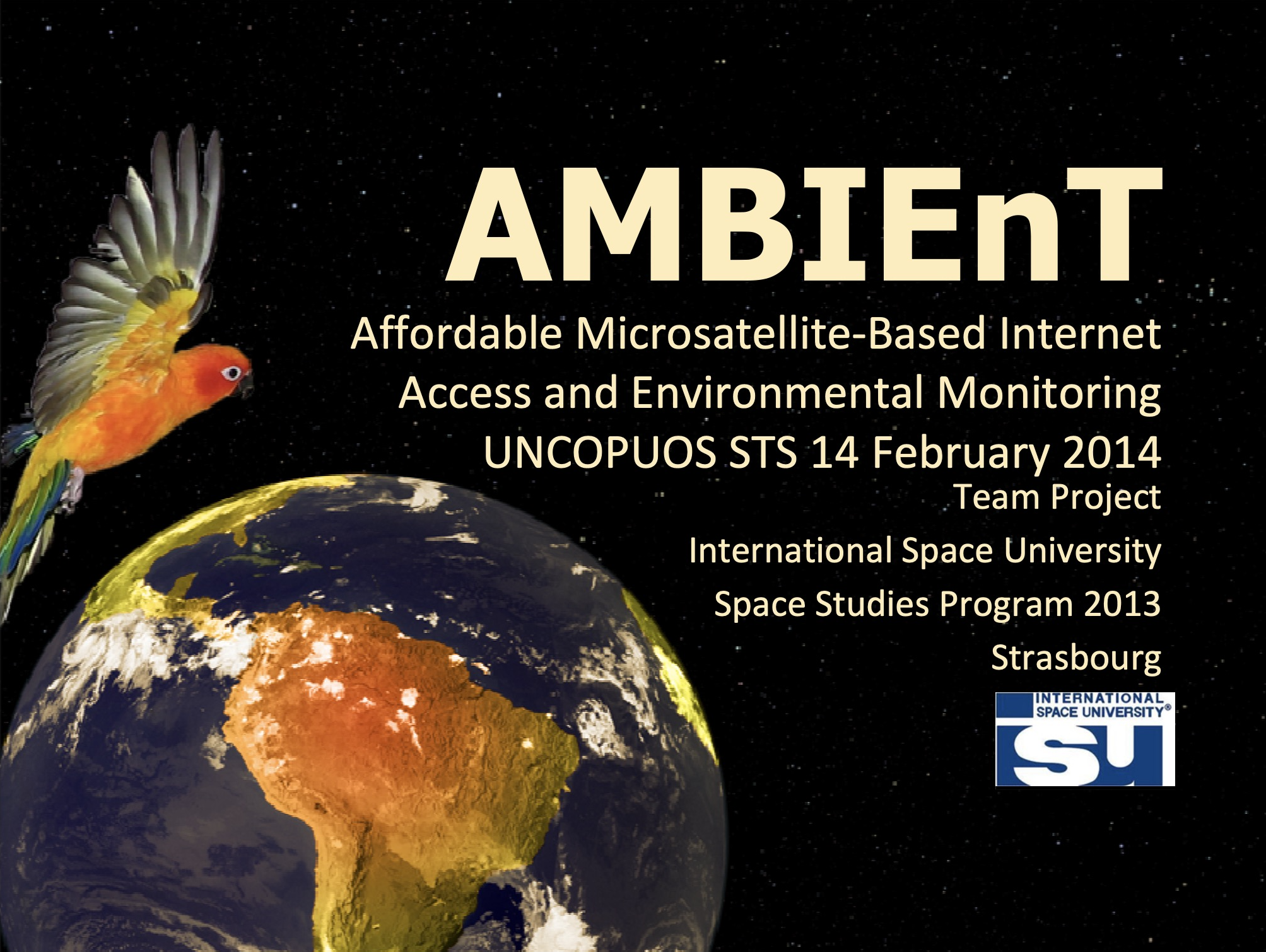
AMBIEnT was an International Space University team project designing a low-cost microsatellite constellation to bring internet access, tele-education, telemedicine and community environmental monitoring to the unconnected Brazilian Amazon, with the potential to expand to other remote regions.
Overview
AMBIEnT (Affordable Microsatellite-Based Internet Access and Environmental Monitoring) was a conceptual design study completed as part of the International Space University (ISU) Space Studies Program 2013 in Strasbourg. The challenge was tackled by 33 participants from 19 countries.
The mission statement was to offer sustainable and affordable internet access and environmental monitoring via a constellation of microsatellites by 2018, as a means to provide socio-economic benefits to the Brazilian Amazon region, with a future capability for global expansion to other remote areas.
The team was chaired by Marco Chamon (INPE) with co-chair Walter Abrahão, teaching associate Raycho Raychev and emerging chair Dag Evensberget.
The challenge
Around 26 million people in the Brazilian Amazon were without reliable internet access. Terrestrial networks struggle in a region of dense forest, long distances and limited infrastructure, widening the digital divide with the rest of the country.
AMBIEnT had to address several linked problems at once:
- Providing basic connectivity at a cost communities could actually sustain.
- Delivering practical services, not only bandwidth: education and healthcare.
- Giving communities tools to help detect and report illegal deforestation.
- Keeping programme costs low enough to be realistic for a microsatellite operator and its partners.
- Meeting international space debris mitigation guidelines.
System concept
The architecture was split into three segments, linked through a ground gateway to the wider internet.
Space segment
- A constellation of 100 kg microsatellites in a 600 km equatorial orbit (0° inclination), giving continuous coverage over the target region.
- Based on the SSTL-100 platform, a bus designed for a seven-year lifetime and with a strong flight heritage.
- X-Band communications using helical antennas.
- Compact spacecraft of roughly 0.4 × 0.4 × 0.7 m, suitable for low-cost piggyback launches.
Ground segment
- Two internet gateway control stations (West and East) with 3 m receiving antennas and signal distribution systems.
- A network of ground stations with helical antennas acting as community hubs.
- Sensor drones attached to ground stations, relaying environmental data to the AMBIEnT processing centre.
User segment
- Municipalities hosting tele-education centres in schools and libraries.
- Public internet terminals in each participating municipality.
- Telemedicine terminals with health-sensor packages linking patients to doctors elsewhere in Brazil.
- Environmental sensors, smartphones and computers connecting to local hubs.
Note on figures: the October 2013 poster describes a design of 14 satellites, 1,161 ground stations and 129 municipalities at an estimated programme cost of $263M. The February 2014 presentation describes an updated baseline of 12 satellites, 110 ground stations, about 48,000 households served, 6–7 years of operational time and a total cost of about $260M over 10 years. The design evolved between the two presentations.
Services
Tele-education
Partnerships with municipalities would establish tele-education centres in schools and libraries, supported by technical education so that local people could operate and maintain the equipment.
Telemedicine
Two options were considered:
- Partnership model: AMBIEnT supplies connectivity and existing telehealth services provide the medical service.
- Own platform: a laptop with text and voice capabilities, a simple user interface and a health-sensor package.
Environmental monitoring
Fixed and mobile ground sensing, together with smartphone apps and weather monitoring, would support timely alerts of illegal deforestation. The aim was to empower communities to act as monitors of their own forests.
Sustainability and business model
AMBIEnT was designed to be provided at no cost to end users. Funding was proposed through financial support from carbon-offsetting collaboration, with the potential for microfinance and new local markets to help sustain the programme and reduce the digital divide.
Implementation milestones:
- 2015: start of production
- 2016: ground station placement begins
- 2017: first of four launches, with on-orbit testing
- 2018: constellation begins operations
- 2019–2024: continued training of key personnel
The system was planned to operate for at least seven years, with a goal of a ten-year programme.
Space debris mitigation
A deorbit analysis showed the satellites decaying from 600 km within about 18 years, satisfying the space debris mitigation guidelines of UN COPUOS (2010) and the Inter-Agency Space Debris Coordination Committee (IADC).
Presentations and outputs
- 6th Wernher von Braun Memorial Symposium, 7–10 October 2013: research poster presented through the University of Alabama in Huntsville and the American Astronautical Society.
- UN COPUOS Scientific and Technical Subcommittee, 14 February 2014: presentation of the team project, delivered by Anita Rinner (ISU SSP 2013 alumna).
- Project video: produced by Dawoon Jung.
What made AMBIEnT distinctive
- An innovative low-cost solution built around microsatellites.
- A packaged offer combining telemedicine, education terminals and mitigation of illegal logging, rather than connectivity alone.
- A clear value proposition for communities, with the possibility of microfinance.
- Sustainability built into both the business model and the orbital design.
My role
Add a short description of your contribution to the team here, for example the work package you led or supported, and any presentation, writing or coordination responsibilities.
Limitations and status
AMBIEnT was a conceptual design study and educational exercise, not a funded flight programme. Its figures, schedules and costs were planning estimates produced within the constraints of the ISU Space Studies Program, and would require detailed engineering, regulatory, spectrum and financing work before any implementation.
Related media
Keywords
Microsatellites; satellite internet; digital divide; Brazilian Amazon; tele-education; telemedicine; deforestation monitoring; environmental monitoring; SSTL-100; X-Band; space for development; space debris mitigation; International Space University; Space Studies Program 2013; UN COPUOS.