Securing Aeolus Against Atomic Oxygen
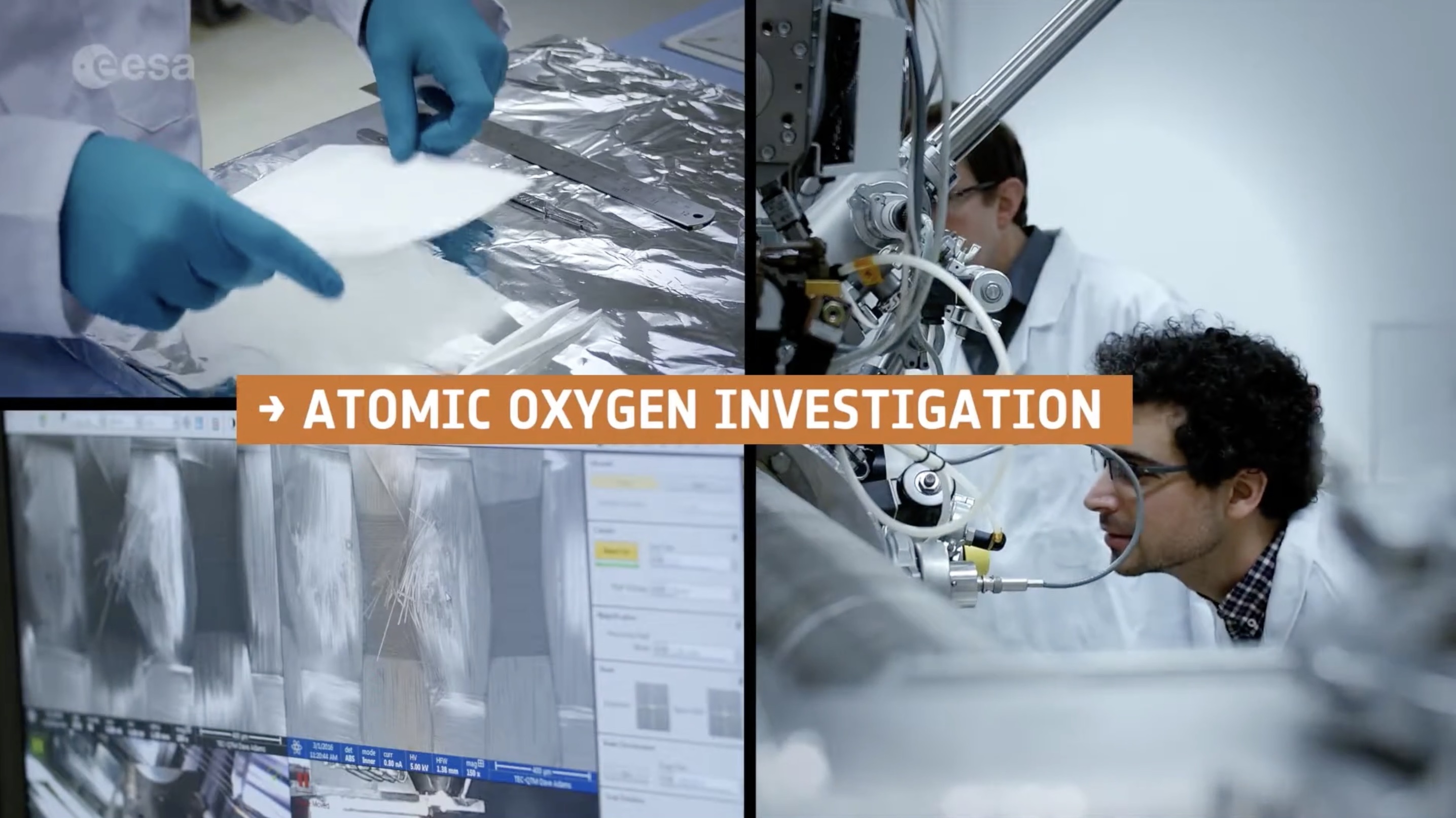
Script development for an ESA documentary exploring how engineers tested protective spacecraft materials for the Aeolus wind-mapping mission against highly reactive atomic oxygen in low Earth orbit.
Overview
Securing Aeolus Against Atomic Oxygen is a short European Space Agency documentary about a small but important spacecraft-engineering problem: protecting satellite materials from atomic oxygen in low Earth orbit.
The film follows testing undertaken for ESA’s Aeolus wind-mapping mission. It shows how engineers at ESA’s Materials and Electrical Components Laboratory assessed the resilience of protective beta cloth, using an atomic-oxygen generator followed by microscopic inspection. [web:283]
I contributed script development through Design & Data, helping make a specialist materials-science process understandable to a public audience.
The challenge
At ground level, oxygen normally exists as stable molecules, (\mathrm{O_2}). At the upper edge of Earth’s atmosphere, ultraviolet radiation can split those molecules into individual oxygen atoms.
This atomic oxygen is highly reactive. Spacecraft operating in low Earth orbit move through it at orbital speed, exposing surfaces to an environment capable of eroding, oxidising or changing the properties of some materials. [web:280][web:287]
The communications challenge was to make an invisible environmental risk visible: → Sunlight breaks oxygen molecules apart → Atomic oxygen forms at high altitude → Satellites encounter it at orbital speed → Vulnerable materials can erode → Testing informs spacecraft design
Atomic oxygen in orbit
Atomic oxygen is a major component of the low Earth orbit environment at altitudes where the residual atmosphere is still present.
Spacecraft motion through this environment produces energetic impacts on exposed surfaces. Organic materials, coatings and some polymers can be especially susceptible to erosion or changes in surface properties. [web:287]
The phenomenon became widely recognised after early Space Shuttle flights returned with visible degradation to thermal-blanket materials. ESA’s video uses this history to explain why spacecraft designers must account for the atomic-oxygen environment before launch. [web:283]
Aeolus mission context
Aeolus was ESA’s Earth-observation mission for measuring global wind profiles. Its instrument used lidar technology to observe winds in the atmosphere, supporting improved understanding of weather, climate and atmospheric dynamics.
The satellite was designed for low Earth orbit, where components and exposed materials had to withstand the local space environment throughout the mission.
Aeolus ended operations in April 2023, but the engineering lessons associated with its development remain relevant to later Earth-observation and low-orbit missions. [web:286]
Beta-cloth testing
The documentary focused on beta cloth, a protective fibre material intended for use on Aeolus.
ESA’s Materials and Electrical Components Laboratory tested the material using an atomic-oxygen generator. This allowed the engineering team to expose candidate material to a simulated version of the orbital environment before the spacecraft was launched. [web:283]
After exposure, the material was inspected under a microscope to identify evidence of surface damage or degradation.
The test sequence can be summarised as: → Candidate material → Simulated atomic-oxygen exposure → Microscopic inspection → Assessment of material resilience → More reliable spacecraft design
Laboratory simulation
Ground testing is essential because spacecraft designers cannot wait for a mission to fly before discovering whether its materials can survive the space environment.
ESA’s Low Earth Orbit Facility generates atomic oxygen in a vacuum chamber to reproduce the energy associated with orbital exposure. The facility can produce an atomic-oxygen beam with energies equivalent to spacecraft travelling at approximately 7.8 km/s. [web:289]
Such facilities enable engineers to test candidate materials under controlled conditions, compare their performance and select protective approaches suitable for the intended orbit and mission duration.
My role
I worked as a Scriptwriter through Design & Data.
My contribution included:
- Developing the documentary narrative and script structure.
- Translating atomic-oxygen physics into accessible language.
- Explaining the relationship between space environment, material testing and mission reliability.
- Supporting the communication of laboratory processes and technical visuals.
- Connecting a small-scale materials experiment with the large-scale purpose of an Earth-observation mission.
The objective was to retain scientific and engineering accuracy while providing a story that could be followed by viewers without a background in materials science or spacecraft design.
Editorial approach
The film used a contrast between familiar oxygen on Earth and the reactive atomic oxygen found near the edge of space.
The oxygen we breathe is not the oxygen a low-orbiting satellite encounters.
This gave the documentary an accessible opening before moving into the specialised work of laboratory testing, protective materials and spacecraft qualification.
Rather than presenting materials science as an abstract engineering discipline, the narrative framed it as a practical safeguard: testing what can happen to a material before it becomes part of an operational satellite.
Outcome
The completed documentary was released by ESA in June 2016.
ESA lists Securing Aeolus against atomic oxygen as a four-minute, English-language documentary released on 24 June 2016. The official description identifies beta-cloth testing, atomic-oxygen generation and microscopic inspection as the central elements of the story. [web:283][web:285]
Related media
Related work
This project is part of wider ESA communication work on the science, materials and engineering that enable European space missions.
See also:
Limitations
This project concerned science communication and documentary scripting. It did not involve conducting the materials tests, designing the Aeolus spacecraft or operating the atomic-oxygen facility.
The test described in the film examined a specific material under controlled laboratory conditions. Full spacecraft qualification also considers other environmental factors, including thermal cycling, vacuum, radiation, vibration, contamination, micrometeoroids and long-term mechanical performance.
Keywords
Aeolus; European Space Agency; ESA; atomic oxygen; low Earth orbit; beta cloth; spacecraft materials; materials science; space-environment testing; Earth observation; documentary scripting; science communication.
ESA’s official video record states that Aeolus beta-cloth material was tested in the agency’s Materials and Electrical Components Laboratory using an atomic-oxygen generator and microscopy; the documentary was released on 24 June 2016.[1]
Sources [1] Videos - 2016 - 06 - Securing Aeolus against atomic oxygen https://www.esa.int/esatv/Videos/2016/06/Securing_Aeolus_against_atomic_oxygen [2] ESA - Securing Aeolus against atomic oxygen https://www.esa.int/ESA_Multimedia/Videos/2016/06/Securing_Aeolus_against_atomic_oxygen [3] Aeolus Overview - Earth Online - European Space Agency https://earth.esa.int/eogateway/missions/aeolus/description [4] LEOX Machine for Generating Atomic Oxygen https://99estec-objects.esa.int/object-items/29 [5] ESA - Aeolus https://www.esa.int/ESA_Multimedia/Missions/Aeolus/(sortBy)/votes/(result_type)/videos [6] ESA Television - Missions - Aeolus https://www.esa.int/esatv/Missions/Aeolus/(sortBy)/view_count [7] Satellite: Aeolus https://space.oscar.wmo.int/satellites/view/aeolus [8] Help: Atomic oxygen erosion - SPENVIS https://www.spenvis.oma.be/help/background/atmosphere/erosion.html [9] ESA - Aeolus https://www.esa.int/ESA_Multimedia/Missions/Aeolus/(result_type)/videos [10] Atomic oxygen generator simulates fire in the sky https://www.esa.int/Enabling_Support/Space_Engineering_Technology/Atomic_oxygen_generator_simulates_fire_in_the_sky