Models of Time-dependent Accretion Discs with Outflows
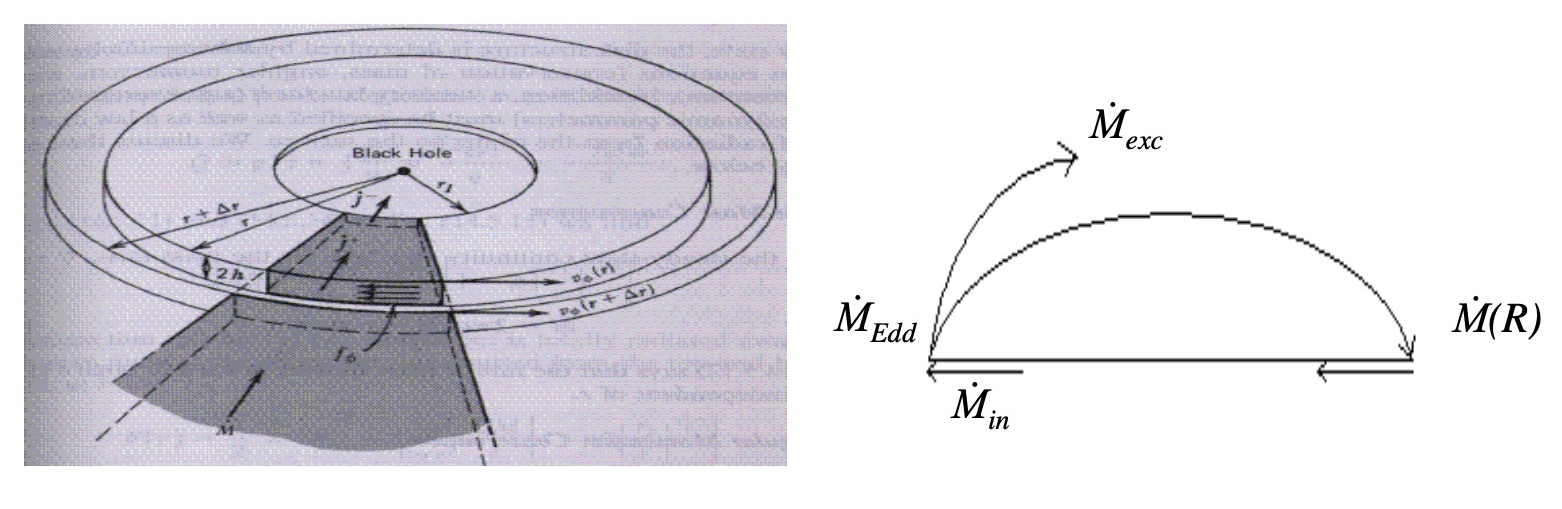
Numerical investigation of time-dependent accretion-disc evolution with mass feedback and outflows. The project developed and validated a Fortran model based on Shakura-Sunyaev disc solutions and wind-infall formulations to examine disc dynamics, angular-momentum transport and wind energy deposition.
Overview
Accretion discs are rotating structures of gas that form when material falls towards a compact object while retaining angular momentum. They are found around young stars, white dwarfs, neutron stars and black holes, including the supermassive black holes that power active galactic nuclei (AGN).
For gas to move inward and accrete, angular momentum must be transported outwards through the disc. The widely used Shakura-Sunyaev alpha-disc model represents this transport through an effective viscosity parameter, alpha. The model provides a useful framework for describing thin, radiatively efficient accretion discs. [web:190][web:194]
This final-year undergraduate research project developed a numerical model of an accretion disc evolving over time while receiving matter and energy from stellar winds or other external mass inflow. The work investigated how the spatial scale and angular momentum of supplied material influence disc structure, mass loss and black-hole feeding.
Research question
How do mass outflows, wind feedback and the angular momentum of supplied material affect the long-term evolution of a time-dependent accretion disc?
The project addressed several connected questions:
- Can a numerical steady-state disc model reproduce established analytical solutions?
- Can the resulting code accurately evolve surface density through viscous diffusion while conserving total mass?
- Does a wind deposited over a large radial scale alter disc evolution differently from a wind concentrated near the central object?
- How sensitive are disc depletion and accretion behaviour to the angular momentum carried by injected material?
- What insight can idealised wind-fed discs provide for low-luminosity galactic nuclei such as Sagittarius A*?
Theoretical context
Accretion and angular momentum
Gas with substantial angular momentum typically settles into a disc rather than falling directly towards a compact object. It can only move inward if angular momentum is redistributed, generally through viscous or turbulent stresses.
In the standard alpha-disc prescription, kinematic viscosity is represented by:
[ \nu = \alpha c_{\mathrm{s}} H ]
where (\nu) is the kinematic viscosity, (\alpha) is a dimensionless efficiency parameter, (c_{\mathrm{s}}) is the sound speed and (H) is the disc scale height. [web:194][web:197]
Shakura-Sunyaev discs
The project used Shakura-Sunyaev thin-disc solutions as the initial and validation framework. In this approach, disc properties depend on the central mass, mass-accretion rate, viscosity parameter and radial distance from the accretor. The model includes regimes in which gas pressure or radiation pressure dominates the disc structure. [web:195][web:196]
Wind-fed accretion
The model then extended the steady-state framework to consider time-dependent mass injection and wind feedback. External material can alter a disc’s surface density, angular-momentum balance and accretion rate, particularly when the incoming material has a different angular momentum from gas already orbiting in the disc.
The project used modified conservation equations based on wind-infall formulations associated with Falcke, Melia and collaborators. These models provide a simplified way to explore the interaction between wind-fed material, disc evolution and accretion onto a central black hole. [web:191]
Numerical model
The numerical model was implemented in Fortran 77, with output analysis and visualisation performed in IDL.
The simulation considered a central black hole with an assumed mass of:
10^8 solar massesThe baseline calculations used:
Accretion rate: 0.1 times the Eddington accretion rate
Viscosity parameter: alpha = 0.1
The Eddington limit provides a reference scale at which radiation pressure from accretion luminosity can oppose further spherical inflow. In realistic disc systems, the relationship between supplied mass, radiation, outflows and accretion can be more complex than this idealised reference value.
Method
Steady-state validation
The initial stage of the project implemented a steady-state disc solver.
Disc profiles were calculated over a range of radii and compared with analytical solutions associated with Svensson and Zdziarski. The validation tested the expected transition between gas-pressure-dominated and radiation-pressure-dominated regimes.
This stage established that the numerical implementation reproduced the qualitative behaviour expected of standard thin-disc models before time-dependent terms were introduced.
Time-dependent diffusion
The model was then extended to evolve the surface-density distribution, (\Sigma(r,t)), over time.
The numerical solution treated viscous evolution as a radial diffusion process. At each time step, the program updated the mass distribution across the disc while tracking total system mass.
Mass-conservation testing showed that the implementation maintained a stable total mass of approximately:
100,729.7 solar masseswithin the numerical precision and boundary assumptions of the model.
Gaussian-ring tests
A Gaussian ring of material was used as a controlled test case for the time-dependent solver.
Under viscous evolution, an initially narrow ring should spread radially: some material moves inwards and can accrete, while some transports angular momentum outwards. The numerical code reproduced this expected spreading behaviour and approached stationary constant-accretion-rate solutions under the relevant boundary conditions.
Wind-feedback implementation
The final stage introduced source terms representing wind-fed mass and energy deposition.
The calculations compared two idealised regimes:
- Large-scale wind deposition, in which material was supplied over an extended radial region, with a collection area reaching approximately 0.1 parsecs.
- Small-scale wind deposition, in which supplied material was concentrated more closely around the disc.
The simulations also tested extreme angular-momentum conditions for the incoming material:
- (\xi = 1), representing supplied matter with high or maximum assumed angular momentum.
- (\xi = 0), representing supplied matter with negligible assumed angular momentum.
These cases were not intended as complete physical models of all wind-fed systems. They were controlled experiments for identifying which assumptions had the strongest influence on the disc’s evolution.
Findings
Large-scale wind deposition
In the large-scale wind models, wind supply dominated the evolution of the disc.
The simulations showed little difference between the extreme angular-momentum cases, (\xi = 1) and (\xi = 0). Once material was deposited over a broad enough radial region, the large-scale mass and energy input determined the overall disc evolution more strongly than the angular momentum parameter of the injected material.
This result suggested that, in this idealised regime, the spatial distribution of wind deposition is more important than the angular-momentum contrast between the two tested cases.
Small-scale wind deposition
Small-scale wind models displayed more distinct depletion behaviour.
The disc mass declined more gradually at first than in the large-scale cases, then underwent a sharper reduction after approximately one million years in the low-angular-momentum condition.
The models also indicated lower final black-hole mass growth than the large-scale cases, by roughly 10 percent under the assumptions used in the simulation.
Super-Eddington phases
Across the tested parameter space, the calculated accretion rates remained above the reference Eddington rate for extended periods, broadly from (10^5) to (10^6) years, before declining as the available disc material was depleted.
These phases should be interpreted within the model’s idealised assumptions. A complete treatment of super-Eddington accretion would require more detailed radiative transfer, geometry, outflow launching and magnetohydrodynamics than were included here.
Relevance to galactic nuclei
The calculations provided a simplified framework for considering wind-fed accretion near supermassive black holes, including environments such as the Galactic Centre.
Such systems can receive substantial mass input from nearby stars while remaining relatively faint in radiative output. The project illustrated how the location, angular momentum and feedback associated with supplied wind material can affect the rate at which gas reaches the central black hole.
Contribution
I completed this project independently as a final-year undergraduate physics student at the University of Leicester under the supervision of Dr Sergei Nayakshin.
My work included:
- Implementing core steady-state disc calculations in Fortran 77.
- Building a time-dependent surface-density diffusion solver.
- Testing mass conservation and numerical stability.
- Performing Gaussian-ring validation experiments.
- Adding parameterised wind-feedback and mass-injection terms.
- Producing IDL routines for diagnostic plots and model comparison.
- Writing the final project dissertation.
Related output
Models of Time-dependent Accretion Discs with Outflows
R. J. M. Laird
Undergraduate Final Year Project Report, Department of Physics and Astronomy, University of Leicester, 27 February 2009.
Supervised by Dr Sergei Nayakshin.
The dissertation documented the theoretical framework, numerical algorithms, Fortran implementation, stability and conservation tests, and comparative evolution plots for wind-fed accretion-disc models.
Scientific significance
Accretion discs connect small-scale gas physics with some of the most luminous phenomena in the Universe. Their behaviour affects black-hole growth, stellar evolution, jet production, AGN activity and the feedback between compact objects and their surroundings.
This project examined a focused aspect of that problem: how external wind supply changes a disc over time. It showed, within the model assumptions, that the radial scale of wind deposition can dominate the outcome, while the angular-momentum state of incoming material becomes more influential when deposition is confined to a smaller region.
Limitations
This was an idealised one-dimensional numerical model, with several important limitations:
- It used a parameterised alpha-viscosity prescription rather than resolving magnetohydrodynamic turbulence.
- It did not model three-dimensional disc structure, warping or non-axisymmetric instabilities.
- Wind mass, energy and angular momentum were introduced through simplified source terms rather than self-consistent wind-launching calculations.
- Radiative transfer and radiation-pressure feedback were treated through simplified disc assumptions.
- Magnetic fields, jet launching and detailed outflow geometry were not included.
- Results depended on the adopted central mass, viscosity, initial conditions, deposition profile and boundary conditions.
The results therefore provide insight into the behaviour of the model rather than a complete prediction for any specific accreting black-hole system.
Keywords
Accretion discs; time-dependent accretion; black holes; active galactic nuclei; wind feedback; outflows; angular momentum; alpha-disc; Shakura-Sunyaev; numerical modelling; Fortran; Sagittarius A*.